

"How much does the device cost?"
It is usually the first question in any container IoT discussion.
It is also the wrong place to start.
When organisations evaluate container digitalisation, hardware is often treated as the investment. In reality, the device is only one component of a much larger operational system. The real investment is the rollout, the data, the workflows, and the organisational change that follows.
A lower device price may reduce procurement costs. It does not necessarily reduce the cost of operating a digital fleet.
Before comparing hardware specifications or requesting quotations, operators should first answer a more important question.
What operational change are we trying to achieve?
Do you want to improve container utilisation?
Reduce dwell time?
Handle exceptions faster?
Increase customer transparency?
Reduce empty repositioning?
Support customs or security workflows?
Every objective requires different data, different reporting logic, different integration requirements, and different operational processes.
The device is only the mechanism that produces reliable field data.
The value appears when that data changes operational decisions.
Without operational change, digitalisation becomes another dashboard.
Container fleets are measured in tens or hundreds of thousands of assets.
At that scale, the purchase price of the hardware is only one part of the equation.
The larger operational questions usually emerge after deployment.
How many installations will be required and at how many different locations?
How often will devices need maintenance?
How frequently will batteries need replacing?
How much operational effort will be needed to keep the fleet running?
How much organisational change is required before the data becomes useful?
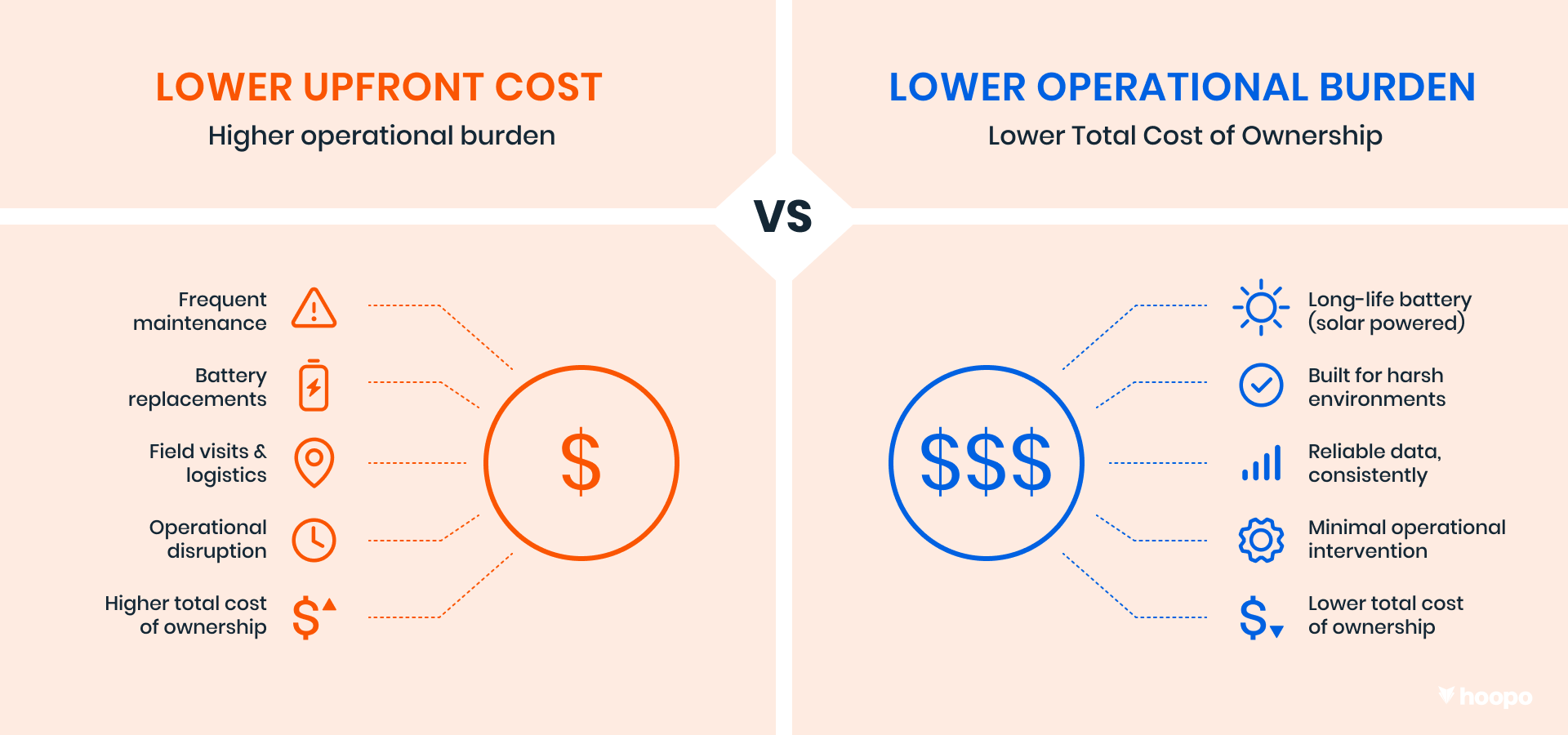
These questions determine the total cost of ownership far more than the purchase price of the device itself.
Container tracking devices operate in one of the harshest environments in global logistics.
Salt. Humidity. Vibration. Mechanical shocks. Pressure washing. Years of continuous operation.
A device that requires repeated maintenance, replacement, or field intervention creates operational work that scales with the fleet.
Every additional touchpoint increases complexity.
The objective is not to minimise the purchase price.
The objective is to minimise operational friction over the lifetime of the fleet.
Battery replacement is often discussed as a technical specification.
In practice, it is an operational process.
The container rarely needs maintenance when it is sitting in the depot next to the maintenance team.
More often, it is on another continent, moving through a customer supply chain, or waiting in a terminal where intervention is difficult and expensive.
What appears manageable during a pilot can become a significant operational programme once thousands of assets are deployed.
The best power strategy is therefore not simply the battery with the lowest cost.
It is the one that requires the least operational intervention throughout the life of the fleet.
A container that can report its location is useful.
A fleet that understands utilisation, detects exceptions, predicts delays, automates workflows, and supports better operational decisions creates considerably more value.
This is where many digitalisation projects succeed or fail.
Tracking is the first layer.
Fleet intelligence is where operational value is created.
Reliable field data becomes operational context.
Operational context enables better decisions.
Better decisions improve utilisation, customer service, and operational efficiency.
The best digitalisation projects are rarely remembered because of the hardware they deployed.
They are remembered because operations became easier.
Teams spent less time searching for containers.
Exceptions were identified earlier.
Customers received better information.
Assets were utilised more effectively.
The technology gradually disappeared into everyday operations because it simply worked.
That is the outcome organisations should optimise for.
The question is not:
"How much does the device cost?"
The better question is:
"How much operational value will this architecture create over the next ten years?"
Because in container logistics, the cheapest hardware is often only the smallest cost in a much larger operational equation.
Marianna Levtov is SVP of Strategic Alliances at Hoopo and ISO Convenor for Smart Containers. Drawing on her experience across container digitization, technology and industry standardization, she writes about the operational realities and challenges shaping the transition to smarter container fleets.

Marianna Levtov, PhD